
Leclerc closes Mercedes gap as Ferrari impresses on Barcelona Shakedown's final morning

Charles Leclerc delivered a statement of intent for Ferrari on the final morning of Formula 1's inaugural 2026 pre-season test, narrowing the gap to Mercedes' benchmark and underlining the Scuderia's competitive trajectory after a week of strong reliability and solid mileage accumulation.
The Monegasque driver's 1m16.653s lap—achieved during a hectic morning session that saw eight cars sharing track time simultaneously—positions Ferrari as a genuine threat as the sport prepares for the Bahrain official test and the season-opening Grand Prix. Leclerc's effort was merely two-tenths slower than George Russell's fastest lap of the entire week, a 1m16.445s set on Thursday afternoon, suggesting that the performance gap between the Brackley team and Maranello may be narrower than the broader timesheet initially indicated.

Ferrari demonstrates week-long resilience
Throughout the Barcelona shakedown, Ferrari has impressed not merely with single-lap pace but with sustained reliability and running. Over the course of their time at the Circuit de Barcelona-Catalunya, Charles Leclerc and Lewis Hamilton accumulated 174 laps, with both drivers consistently operating in the 1m18s. By Friday morning, Leclerc had elevated his performance to challenge Russell's earlier benchmark, completing 79 laps and showcasing the kind of consistency that Ferrari struggled to demonstrate in previous regulation cycles.
The team's ability to generate meaningful data across diverse weather conditions—including the rain encountered on Tuesday—has provided engineers with valuable baselines for development heading into the next phase of testing.
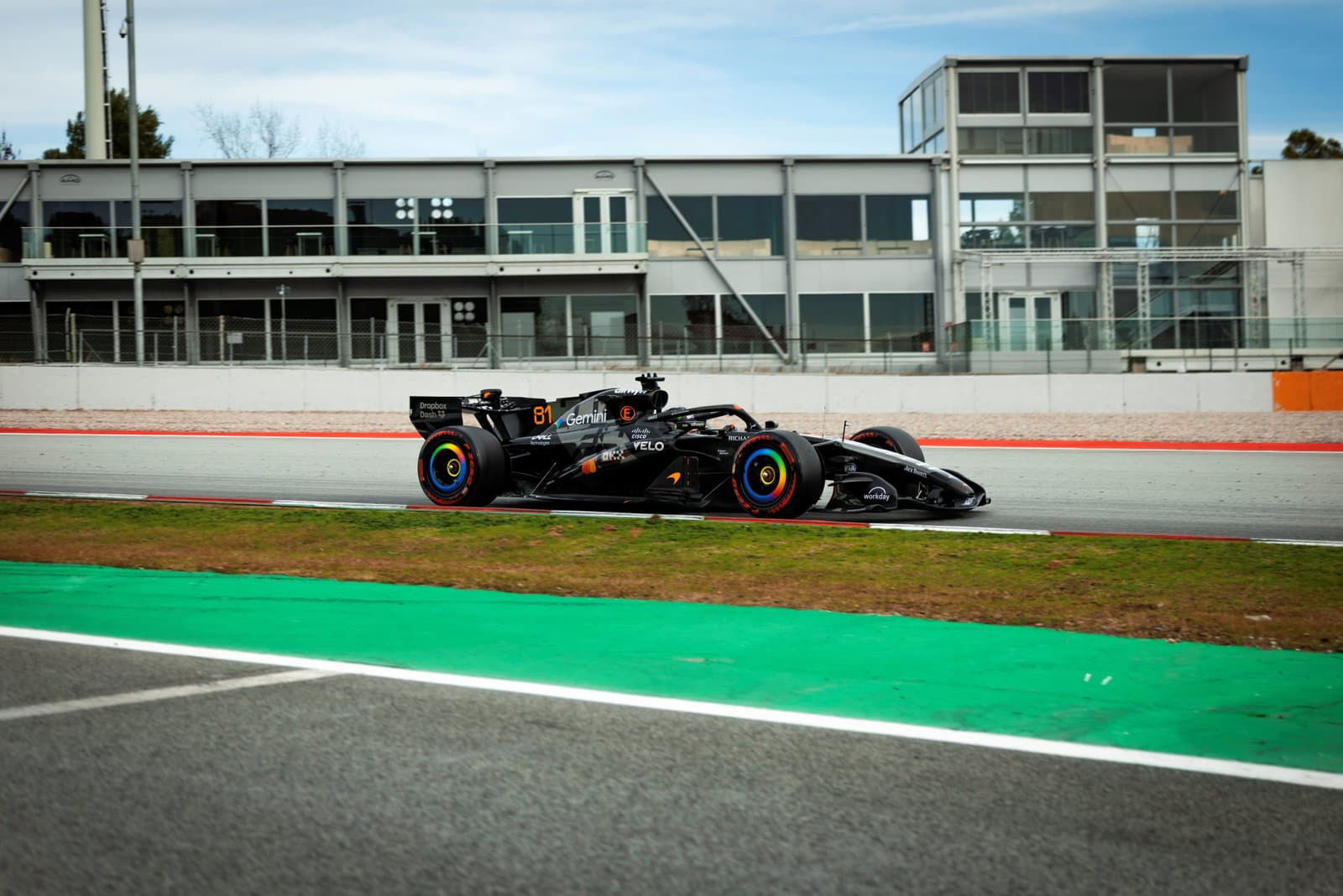
Piastri returns,Verstappen breakout session
Oscar Piastri rebounded from Thursday's fuel system disruption to secure second place, posting a 1m17.446s and completing 79 laps as McLaren worked through its SF-26 development programme. Despite running one second off Russell's pace, Piastri's restored running time allowed the team to gather critical feedback following Wednesday's morning-session disruption.
Max Verstappen, meanwhile, finally enjoyed an uninterrupted session following Red Bull's parts replacement. Despite a minor excursion at Turn 10, the four-time world champion classified third with a 1m18.285s, suggesting Red Bull has resolved the mechanical issues that limited its earlier programme.

Alonso's first lap
Friday's most captivating storyline centered on Fernando Alonso's maiden appearance in Adrian Newey's revolutionary AMR26. The Aston Martin design, which features the sport's most distinctive aerodynamic concept, proved reliable enough to allow Alonso 49 exploratory laps, including a best time of 1m20.795s. Though Alonso maintained conservative speeds on the main straight—a common practice during initial evaluation runs—the sheer fact that the car completed nearly 50 laps without incident represented substantial progress for Aston Martin after Lance Stroll's red-flag-inducing accident on Thursday.
Ollie Bearman's workhorse performance for Haas was equally noteworthy, as the British driver circulated 106 times—exceeding the century mark and generating the session's highest lap count. This productivity underscored Haas's determination to recover from earlier mechanical setbacks.

Implications for Bahrain
With eight competitive entries sharing Barcelona's track surface simultaneously, the complexity of extracting meaningful comparative data intensified. Fuel loads, aerodynamic configurations, and ERS deployment strategies all obscure straightforward performance comparisons. Nevertheless, Leclerc's commanding display provided Ferrari genuine encouragement as the paddock transitions to Bahrain's official test venue, where the competitive hierarchy will crystallize under more standardized conditions.
As Mercedes concludes its Barcelona allocation having deployed 499 combined laps across the week, the stage is set for the sport's elite teams to demonstrate whether the early technical solutions and regulatory interpretations represent genuine performance advantages or temporary testing anomalies.

Simone Scanu
He’s a software engineer with a deep passion for Formula 1 and motorsport. He co-founded Formula Live Pulse to make live telemetry and race insights accessible, visual, and easy to follow.