
Mercedes reclaims F1 Safety Car throne: Aston Martin exits after five-year partnership

Mercedes will become the sole supplier of Formula 1's safety and medical cars in 2026 following Aston Martin's decision not to renew its contract. The partnership that redefined the sport's support vehicle dynamics for half a decade comes to a close, marking a significant shift in the championship's operational landscape. Aston Martin's departure concludes a tenure that, despite considerable investment in performance upgrades, ultimately proved untenable for the British manufacturer.
The announcement represents the end of an experiment that saw Mercedes relinquish its quarter-century monopoly on F1 safety car duties. Since 1996, the German automaker had maintained exclusive responsibility for this critical role. However, from 2021 onwards, Aston Martin shared the responsibility, with the two manufacturers alternating at each grand prix—a partnership that sparked both innovation and considerable controversy.

A rocky beginning: the "green turtle" era
Aston Martin's initial foray into safety car provision proved deeply problematic. The Vantage F1 Edition that debuted alongside the partnership suffered from significant performance deficiencies compared to its Mercedes counterpart. Weighing 45 kilograms more than the AMG GT Black Series while producing 200 bhp less power, the Aston Martin struggled to maintain pace during safety car procedures.
The shortcomings became impossible to ignore on track. Four-time World Champion Max Verstappen famously critiqued the vehicle's sluggish performance at the 2022 Australian Grand Prix, dubbing it the "green turtle" in reference to both its livery and lethargic speed. "The safety car was driving so slow, it was like a turtle. Unbelievable," Verstappen remarked at Melbourne, questioning the necessity of such restricted pace when no damaged cars were present.
These criticisms extended beyond frustrated driver commentary—they highlighted genuine operational concerns within the paddock regarding safety car effectiveness during race management scenarios.
Aston Martin's redemption attempt
Recognizing the deficiencies plaguing its safety car program, Aston Martin invested substantially in performance enhancements. For the 2024 season, the manufacturer introduced a fundamentally revised Vantage model featuring 656 bhp generated by an AMG-supplied 4.0-litre twin-turbo V8, representing a 150 bhp improvement over its predecessor. The upgrade successfully narrowed the performance gap with Mercedes' offering.
The manufacturer pushed further still. During the 2025 Dutch Grand Prix, Aston Martin unveiled the Vantage S, equipped with a V8 engine producing approximately 670 bhp and featuring aerodynamic upgrades including a new rear deck spoiler. These improvements represented genuine technical advancement, demonstrating Aston Martin's commitment to meeting F1's exacting standards.
Despite these considerable investments and iterative refinements, Aston Martin elected to withdraw entirely from safety car duties. The decision remains officially attributed to the natural conclusion of the contractual arrangement, though commercial considerations likely played a decisive role.
Mercedes returns to exclusivity
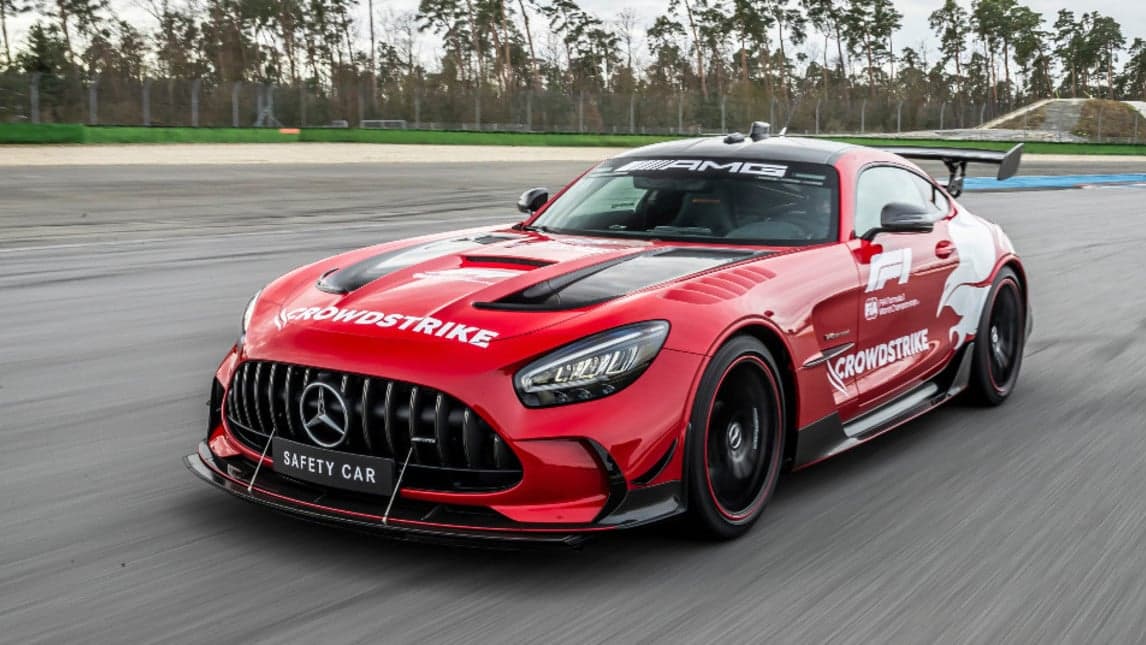
Mercedes will now supply both safety and medical cars to all 24 rounds of the 2026 season, resuming the operational model it maintained for three decades prior to 2021. The familiar AMG GT Black Series—producing 730 bhp—will continue in its safety car capacity, now featuring the distinctive red livery of title sponsor CrowdStrike rather than traditional Mercedes silver.
The medical car, based on the Mercedes-AMG GT 63 S 4MATIC+, generates 639 bhp and accelerates from 0-100 km/h in just 3.2 seconds, ensuring rapid response capability throughout race weekends.
This consolidation eliminates operational complexity while restoring consistency to safety procedures—a factor that clearly resonated with championship stakeholders frustrated by the performance disparities of recent seasons.
Bernd Maylander's continued legacy
German racing legend Bernd Maylander will continue his remarkable tenure as the FIA's safety car driver, having held the position since 2000. Now entering his 26th season in this specialized role, Maylander's experienced hand will pilot Mercedes' consolidated safety car operation, ensuring continuity during critical on-track moments.
What's next for F1's support vehicles?
While Mercedes returns to sole supplier status, industry observers note that F1 may revisit the concept of multiple suppliers in the future. However, any successor arrangement would require a manufacturer capable of delivering performance parity with Mercedes' precision engineering—a considerably higher bar than Aston Martin ultimately satisfied.
For now, Mercedes has reclaimed its position as the architect of Formula 1's safety infrastructure, reinforcing its deeper integration within the sport beyond its competitive team operations.

Simone Scanu
He’s a software engineer with a deep passion for Formula 1 and motorsport. He co-founded Formula Live Pulse to make live telemetry and race insights accessible, visual, and easy to follow.