
Mercedes W17's real-world performance "exceeds simulator expectations"

Mercedes has every reason to be optimistic ahead of the 2026 Formula 1 season. Following a productive Barcelona shakedown test, the Silver Arrows discovered that their revolutionary W17 is already performing better on track than months of simulator work suggested it would. Most significantly, the team has successfully resolved what appeared to be a critical weakness: the driveability of the all-new hybrid power unit that will define this unprecedented regulatory era.
George Russell's second-fastest time on the opening day of Barcelona testing—just half a second behind Red Bull's Isack Hadjar—underscores Mercedes' strong preparations for F1's biggest technical reset in decades. But beyond the timesheets, it's the qualitative feedback from both Russell and teammate Kimi Antonelli that reveals the true picture: Mercedes' W17 feels more intuitive to drive than the team ever experienced in the virtual environment.
The simulator-to-track reality check
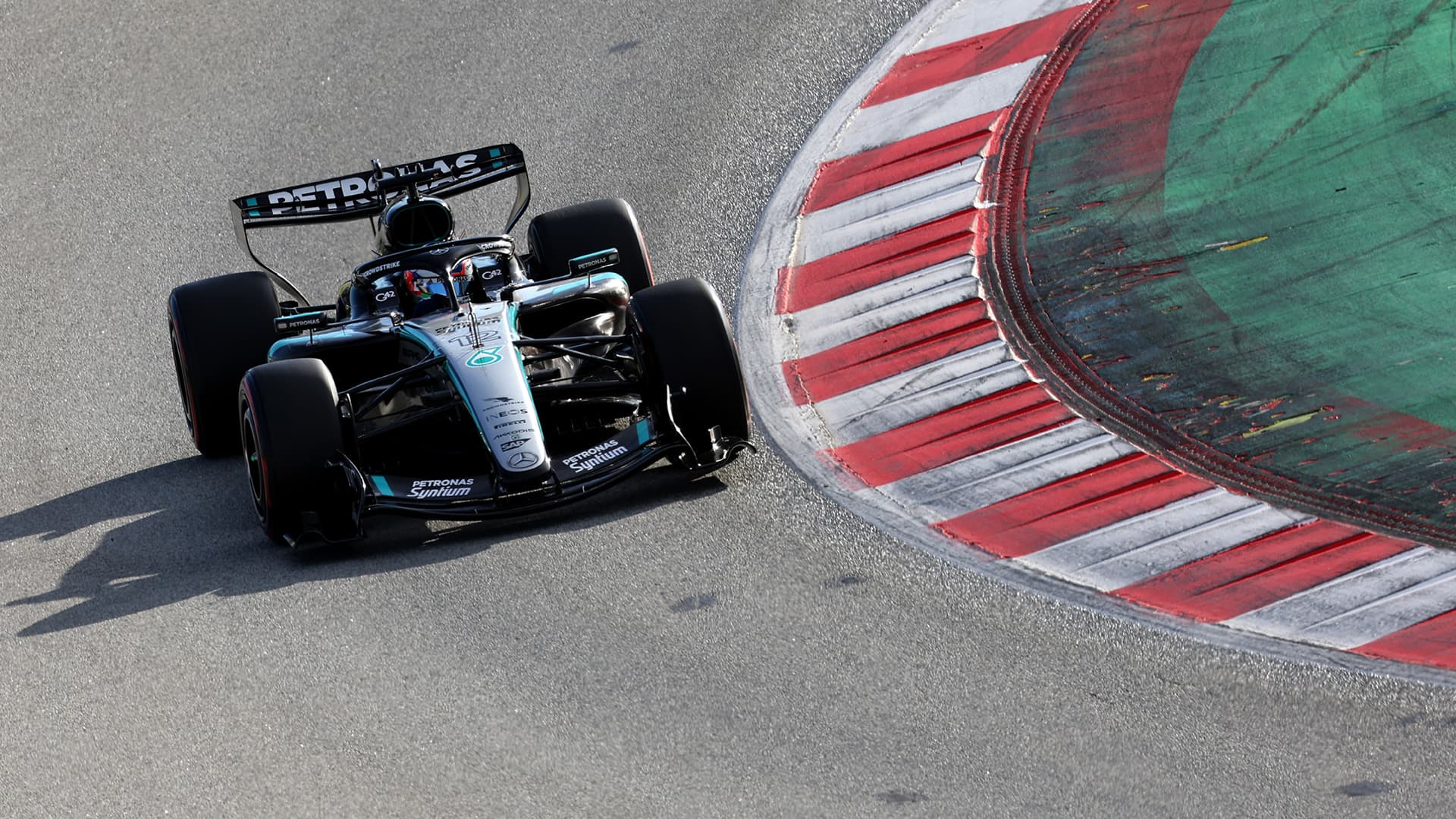
Before Mercedes conducted its Silverstone shakedown last week, the team's entire experience with the W17 existed in the digital realm. The transition from simulator to circuit is always revealing, but rarely does a car feel better on track than in the virtual model—yet that's precisely what Mercedes encountered.
"Prior to Silverstone, their experience of it was all in the virtual world, in the simulators," explained Mercedes trackside engineering director Andrew Shovlin. "And in a number of areas it's actually feeling better to them on track than they were feeling in the simulator. So that's certainly encouraging."
This insight is more significant than a simple confidence boost. It suggests that Mercedes' correlation—the critical alignment between simulator data and real-world behaviour—has validated the team's approach to designing a chassis around the 2026 regulations. The W17, which is smaller, narrower, and lighter than its predecessor, appears to behave predictably in ways that engineers can trust and iterate upon.
The driveability question mark resolved
Among the numerous unknowns surrounding the 2026 regulations, few concerns loomed larger than engine driveability. The new power unit, developed by Mercedes and Petronas, represents a seismic shift in F1 propulsion: a near-50:50 split between combustion and electric power, with the uprated MGU-K delivering almost half of the engine's maximum deployment.
Integrating an electric motor system of this magnitude into the fundamental driving experience was the "big question mark" hanging over Mercedes' entire programme. How would 149 horsepower from the motor layer integrate with the traditional combustion engine? Would it deliver smooth power deployment, or would drivers encounter the kind of lag and disconnect that plagues hybrid systems in less sophisticated environments?
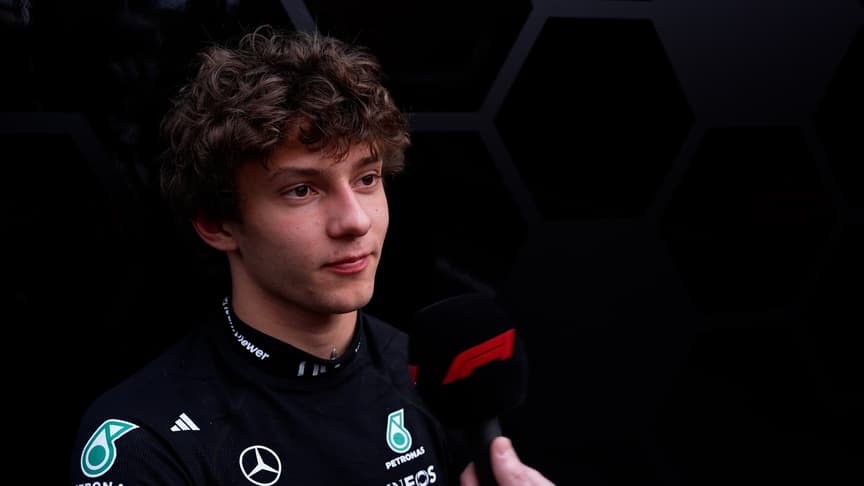
Kimi Antonelli provided the answer during Barcelona testing: "The team did a really good job on driveability, which was a big question mark." The Italian driver, who sampled the W17 during the morning session when the track was damp before conditions dried, emphasized that the package is "feeling good" in its earliest iteration.
This resolution of the driveability concern is critical. Unlike traditional development cycles where engineers have seasons to refine drivability, Mercedes must establish a solid baseline immediately, with only weeks before the season opener in Melbourne. The fact that both drivers reported the hybrid system feels intuitive suggests the team's years of development—particularly on the power unit side at Brixworth—have paid dividends.
A monumental engineering achievement
Mercedes' trackside leadership is rightfully proud of what has been accomplished in preparation for this moment. The 2026 regulations represent an entirely new ecosystem: new chassis, new power units, new fuel specifications, new electronic systems, and aerodynamic philosophies that bear little resemblance to the previous generation.
"It has been an absolutely monumental project," Shovlin reflected. "And on the power unit side in Brixworth, they've been working on it for years, a very, very difficult and challenging programme. You've also got all the complexity that the fuel development throws into that with Petronas. And then on the chassis side, a completely new set of regulations."
The immediate success of the Silverstone shakedown—where Mercedes completed a full first day without incident—and the productive Barcelona test underline this preparation. Russell and Antonelli combined for 149 laps on Monday, with Russell alone posting 93 laps in the afternoon. This consistency suggests Mercedes' manufacturing, systems integration, and reliability foundations are sound, allowing the team to focus on the substantive work: understanding performance margins and optimizing across all systems.
Technical innovation: the W17's distinctive design
.webp&w=3840&q=75)
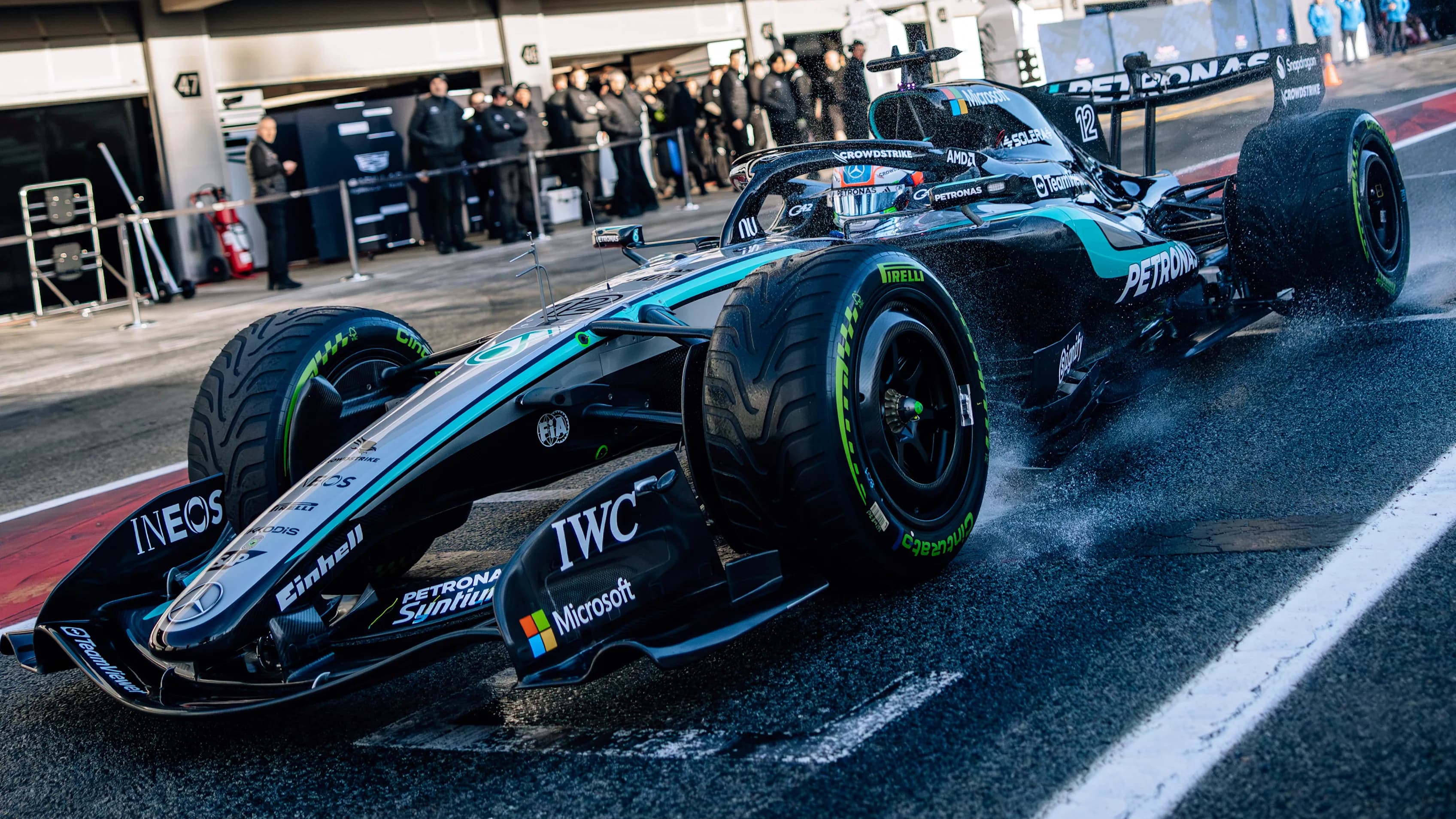
The W17's design reveals Mercedes' strategic approach to the new regulations. The car features active aerodynamics with moveable front and rear wings—a technology absent from F1 since 2013. Technical analysis reveals Mercedes has adopted some unconventional solutions, particularly in how it's configured the front wing and floor structure.
The retained pushrod front suspension, a minority choice in 2025 but increasingly common for 2026, reflects the weight-saving imperative of the new 770kg minimum. Mercedes' design language, particularly the emphasis on rear downforce generation and distinctive floor board vane alignment, suggests the team is committing to specific aerodynamic philosophies that may differentiate it from competitors as the season progresses.
The livery, too, reflects Mercedes' evolution: the iconic silver and black remain, but a dynamic Petronas green flow line now anchors the design, emphasizing speed and precision. Meanwhile, Microsoft replaces Alpine as a prominent partner, visible on the airbox and front wing endplates.
Cautious optimism, not overconfidence
While Mercedes' early data is encouraging, both the team and its drivers are maintaining appropriate perspective. Russell, despite his strong showing, deliberately avoided grandiose claims.
"We're all just excited to get to Melbourne," Russell said. "Of course, days like today are needed, and the shakedown, testing in Bahrain is really important next up as well. But it's only come Melbourne qualifying, Melbourne race, that we'll get a true indication of who's on top."
Shovlin echoed this measured approach, emphasizing that Mercedes is "really just at the very, very embryonic stages of the test programme" and that long-run data collection and power unit optimization remain priorities for the remaining test days.
Conclusion
Mercedes enters 2026 with significant advantages: a comprehensive development programme, solid simulator-to-track correlation, resolved concerns about hybrid driveability, and early competitive performance. The Barcelona test provided not just a favorable headline—Russell's P2 finish—but validation that months of preparation have translated into tangible advantage.
Yet the real test awaits in Melbourne. With Red Bull also showing strong early pace and Ferrari's development philosophy yet to fully materialize, the competitive picture remains fluid. What's clear, however, is that Mercedes' gamble on meticulous preparation during the regulatory transition has positioned the team to "get stuck into the real learning," as Shovlin noted, from a position of genuine strength.
The W17, it seems, is ready. Now Mercedes must prove it can convert simulator success and early testing advantages into a championship-contending package.

Simone Scanu
He’s a software engineer with a deep passion for Formula 1 and motorsport. He co-founded Formula Live Pulse to make live telemetry and race insights accessible, visual, and easy to follow.