
The F1 movie takes pole position: how the blockbuster is dominating Apple TV

If you thought the checkered flag on Brad Pitt's high-octane racing drama F1 had already waved, think again. After a blistering theatrical run this past summer, the Joseph Kosinski-directed blockbuster has found a second wind---and plenty of grip---on the small screen.
As of this morning, December 16, 2025, just four days after its streaming debut, F1 has rocketed to the number one spot on the Apple TV charts, overtaking holiday favorites and established series alike.
For those of us who live and breathe Formula 1, this isn't just a win for Apple or Hollywood; it's a victory lap for the sport itself. But what is it about this specific film that has captivated both the die-hard tifosi and the casual "Drive to Survive" convert? Why has it resonated so deeply in the American market, and does it actually get the technical details right?
Buckle up. We're going deep into the telemetry to analyze why F1 is the streaming champion of the world right now.
From theatrical podium to streaming gold
Let's look at the data. When F1 hit theaters back in June 2025, the stakes were incredibly high. With a reported budget hovering near $300 million (thanks in part to the complexities of filming during actual Grand Prix weekends and the interruptions of the 2023 strikes), the film needed to perform like a Red Bull in clean air to turn a profit.
And perform it did.
Garnering approximately $631.5 million at the worldwide box office, F1 didn't just break even; it became the highest-grossing film of Brad Pitt's entire career, officially surpassing his previous record-holder, World War Z. While it didn't quite reach the stratospheric heights of Kosinski's previous masterpiece, Top Gun: Maverick, it proved that a racing film---historically a niche genre---could pull in mainstream blockbuster numbers.
Now, its arrival on Apple TV+ on December 12 has unleashed a second wave of momentum. The rapid ascent to No. 1 suggests that while millions saw it in IMAX (the format it was practically built for), millions more were waiting to experience the thrill from the comfort of their living rooms. This "double-dip" success is rare and points to a movie with high re-watchability---a crucial metric for streaming longevity.
The "realism" factor: Lewis Hamilton's fingerprints
I've seen my fair share of racing movies that make fans cringe. We all remember the days of cars shifting gears 50 times in a straight line or exploding upon minor contact. F1 is different, and the reason is simple: Lewis Hamilton.
Serving as a producer and technical advisor, the seven-time World Champion's influence is stamped on every frame of this film. Hamilton was adamant that the film respect the physics, the politics, and the sheer violence of the sport.
Practical effects vs. CGI
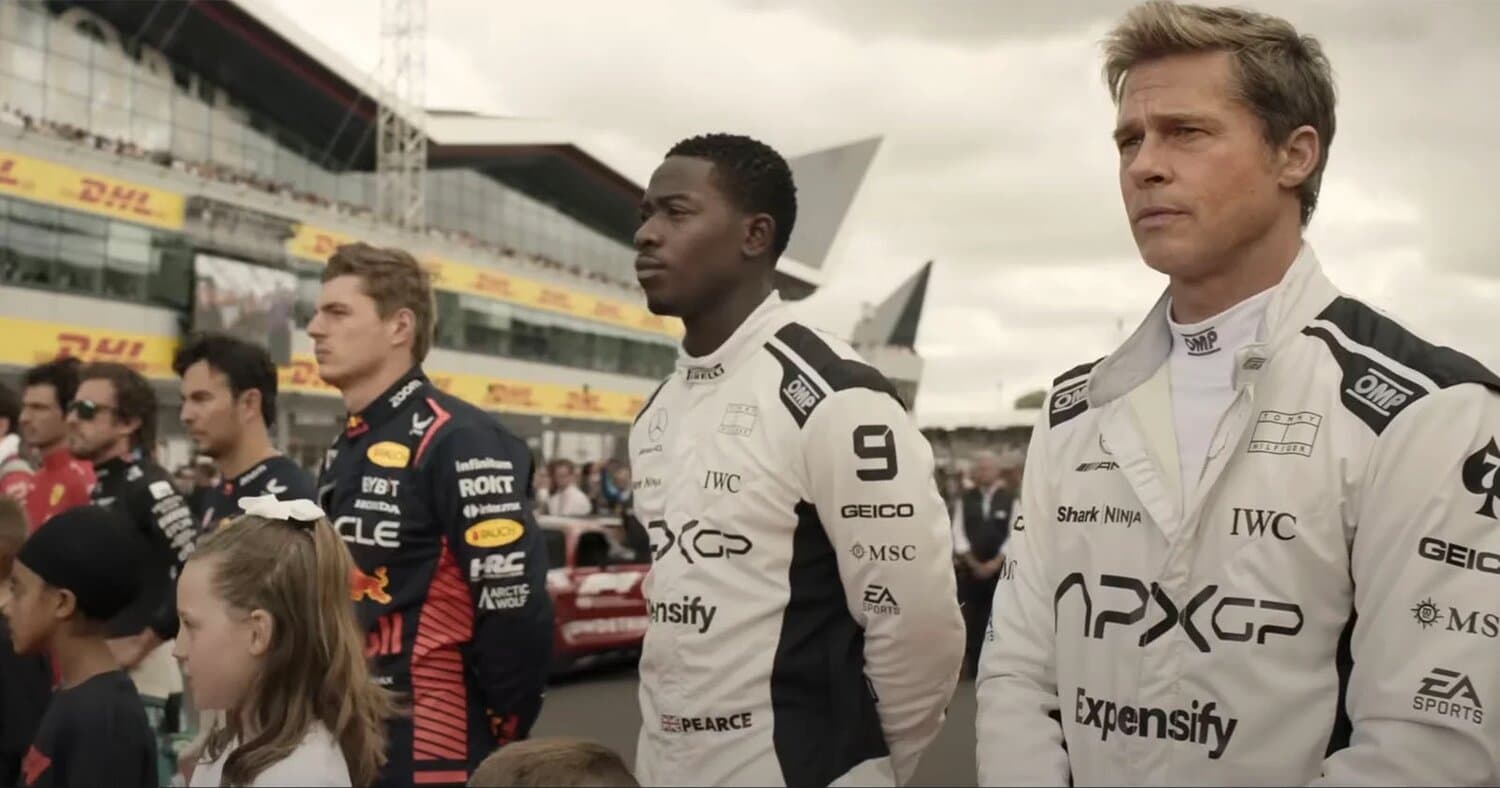
The production team, led by Kosinski, made the unprecedented decision to embed a fictional 11th team, APXGP, into the real 2023 and 2024 Formula 1 seasons. When you see Brad Pitt (as veteran Sonny Hayes) or Damson Idris (as rookie Joshua Pearce) in the cockpit, they aren't sitting in a green screen studio in Burbank. They are in modified Formula 2 chassis---disguised as F1 cars---actually driving at speed around Silverstone, Spa-Francorchamps, and Monza.
This commitment to practical effects creates a visceral, vibrating reality that CGI simply cannot replicate. The camera mounts were developed specifically to capture the G-force rattling the drivers' helmets. For the F1 purist, this is the film's greatest triumph: it feels heavy. It feels dangerous.
The APXGP narrative
The story of APXGP---a struggling backmarker team fighting for a single point---mirrors the real-life midfield battles we see every Sunday. It's a love letter to the teams like Williams or Haas, where survival is just as intense as the fight for the championship. Hamilton's input ensured that the team dynamics, the radio chatter, and even the tire strategies felt authentic to the modern era of the sport.
The verdict: critics vs. the grandstands
In the world of Formula 1, the stopwatch never lies. In Hollywood, however, the metrics are a bit more subjective. F1 has created an interesting divergence between professional critics and the paying audience---a gap that actually explains its massive streaming success.
-
Rotten Tomatoes Critic Score: 82% (Certified Fresh)
-
Rotten Tomatoes Audience Score: 97%
While critics largely praised the technical mastery and the sound design, some pointed to a predictable, "sports movie" script. But the 97% audience score tells the real story. Fans don't care if the "redemption arc" is a classic trope; they care about the execution. They care about the roar of the hybrid engines, the tension of a pit stop, and the chemistry between the old guard (Pitt) and the new blood (Idris).
This massive audience approval rating is the engine driving its Apple TV dominance. Word of mouth is powerful. When 97 out of 100 people tell their friends, "You have to see the racing scenes in this movie," it creates a viral loop that algorithms can't manufacture. It's "Verified Hot" for a reason---it delivers exactly what the trailer promised: pure, unadulterated speed.
The "Drive to Survive" effect: conquering america
We cannot talk about the success of F1 without acknowledging the elephant in the room: the United States.
For decades, Formula 1 was a European pastime that America largely ignored. Then came Netflix's Drive to Survive, cracking the market wide open. F1 (the movie) is the cinematic culmination of that growth. It is designed to appeal to the new generation of American fans who view the sport not just as racing, but as a drama of personalities, money, and ego.
The film's performance in the US---where it grossed nearly $190 million domestically---proves that F1 is no longer a niche interest across the Atlantic. It has become a cultural pillar. By casting a Hollywood titan like Brad Pitt and pairing him with a rising star like Damson Idris, the film bridged the gap between "car people" and "movie people."
Apple, having acquired the rights in a massive deal, is banking on this synergy. With their increasing investment in live sports broadcasting, having the biggest sports movie of all time sitting at the top of their chart is a strategic masterstroke. It reinforces the brand's association with premium, high-octane content.
Why you should stream it tonight
If you missed it in theaters, or if you're debating a re-watch, here is my professional recommendation: Do it.
For the casual viewer
It's a fantastic underdog story. You don't need to know what a DRS zone is or understand tire compounds to feel the emotional weight of Sonny Hayes trying to prove he's not obsolete. It's Top Gun on wheels---fast, loud, and surprisingly emotional.
For the F1 expert
Watch it for the easter eggs. Look for the cameos of Max Verstappen, Charles Leclerc, and Guenther Steiner. Appreciate the fact that the cars are on the correct racing line. Marvel at the sound design that distinguishes between a gear shift and a downshift. Yes, it's a movie, and yes, they take some creative liberties for drama, but it is the most respectful and authentic depiction of our sport ever put to film.
Final lap
F1 hitting number one on Apple TV isn't just a statistic; it's a statement. It confirms that Formula 1 has successfully transitioned from a weekend sport to a 24/7 entertainment juggernaut.
Brad Pitt and Lewis Hamilton set out to make a movie that respected the grid. The result is a blockbuster that has not only conquered the box office but is now dominating the streaming wars. If this is the future of F1 in media, then lights out and away we go.

Simone Scanu
He’s a software engineer with a deep passion for Formula 1 and motorsport. He co-founded Formula Live Pulse to make live telemetry and race insights accessible, visual, and easy to follow.